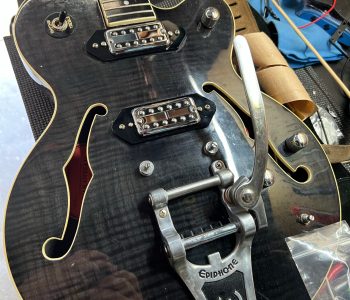
A Polarizing Guitar: The Epiphone Wildkat
I already mentioned how I snagged an Epiphone Firebird VII on the cheap, and how I was offered it from the seller of a different guitar I was buying. This first guitar I was making at go at was a used 2001 Epiphone Wildkat.

So to be clear, I’ve always wanted an Epiphone Wildkat, but never that badly. So I never rushed out to purchase one new because I didn’t know if it’d be practical for what I needed. There was also that nagging, superficial part of me that felt like the Wildkat was ripping of Gretsch, so I wasn’t always motivated to make the move. However, I was always watching to see if someone would list one on the cheap, but that hunt would always prove fruitless for me as most people wanted at the very least $400 for a used one. Sure, that’s still a great price, but not good enough to satisfy my own uncertainty.
But a 2002 Translucent Black Wildkat appeared on OfferUp for $200, and was super clean. There’s not even a chip on it. Best yet, it was listed right here in Burbank making it a quick commute to snag it before anyone else could.
At the time, I had pretty much no money. The recent move to the new house exhausted pretty much all of our available funds. But I made it work. However, the real strain came in when the seller said he also had an Epiphone Firebird VII for $350, which I talked about in a previous blog post. Well, yeah. Clearly I had to get both. …Wouldn’t you?

When I got it home, this guitar was the clear winner as for playability. The neck is a nice modern C shape and is easy to maneuver around. There was zero dead spots on the fingerboard and the action was nice and low. The only real issues was that the Bigsby copy being a bit squeaky and the P90s sounding dull and lifeless. But I had plans for this, of course. Something I’ve wanted to do for a long while.
I had a set of Artec Filtertrons that I’d ordered for another project caught up in a standstill. I wasn’t sure what to think of these but they looked the part. I had no experience with these either. The Artecs I used here are built with AlNiCo Ⅴ magnets, so I knew I was going to get some bright attack, which is an element I love in that Rockabilly sound. But what I really appreciated about Artec Filtertrons is there not being any markings on the covers. No branding, no identifiers of any kind. Most who know me personally knows I love Guitar Fetish’s pickups. But I’m sorry, I’m not putting a Filtertron in that’s branded “GF’Tron”. Call me shallow, but I just can’t bring myself to do it. I don’t like markings on any of my pickups, including Seymour Duncan. It just bugs me to see it on my guitars.
The other thing is the stock wiring. Epiphone used so much friggin wire in this thing, it added capacitance to the signal. So I rebuilt a wiring harness based upon Gretsch’s own wiring diagrams. I used Bourns long shaft 500k pots, an orange drop cap, braided wire, and a Switchcraft output jack.
Now it was time to figure out the pickups. I don’t like leaving exposed screw holes, nor did I want to try and fill the dog ear screw holes on a translucent black guitar. So I knew I needed dog ear adapters for a Filtertron pickup. Well, I didn’t find actual polished chrome adapters like I would have appreciated. Instead the best I could find was from TV Jones, which I ordered through the awesome and generous Sweetwater who had them in stock with shipping included (which I paid full price for, and was not sponsored). I bought from Sweetwater as they offered complimentary shipping, whereas TV Jones’ website listed the adapters at the same price, but charged separate shipping. Which I wholeheartedly respect, but opted to save money from Sweetwater.
The dog ear adapters arrived quickly, along with Sweetwater’s generous helping candy. So now it was time to install the new harness, which surprisingly wasn’t as difficult as my 1989 Sheraton Ⅱ was or any other semi-hollow for that matter. Everything went right in through the pickup cavities, and the TV Jones dog ear adapters were a complete and perfect fit for the Artec Filtertrons. Yes, sacreligious. But effective.

After stringing it up, I still had to figure out what to do about that obnoxiously squeaky vibrato system. My guitar bench is also right next to my everything else workbench. Above that was a can of garage door lubricant amidst various WD-40 cans, spray silicone, oils, etc. I figured garage door lube has a high tolerance to just about everything. One little spritz and the squeaking was gone. Not only was the squeak eliminated, but the vibrato returns to a nice, stable zero point each time. Compared to the Bigsby’s I’ve played on Gretsch guitars, the Epiphone variety has a stiffer spring. But I kind of appreciate that aspect. It works, and works super well doing the job I expect.
So now I have this amazing guitar that Epiphone should have been building this entire time. It’s bright, jangly, breaks up nicely, and plays perfectly after going through everything else to clean and polish. I’m actually surprisingly happy with the Artec Filtertrons. For the money, you kind of can’t beat ‘em. Sure I could have thrown down for some TV Jones or Gretsch Filtertrons. But I didn’t want to spend more on pickups than the guitar’s overall value. That never sits well with me as a budget instrument will always be a budget instrument no matter what’s done to it.
We’ll likely get a video shot about this, hopefully sooner than later.


